
目录(7 节)

·
Wall Street Arrives With ETFs: Client or Competitor?
2024–2025 Spot bitcoin ETFs, concentrated custody and Wall Street’s double role
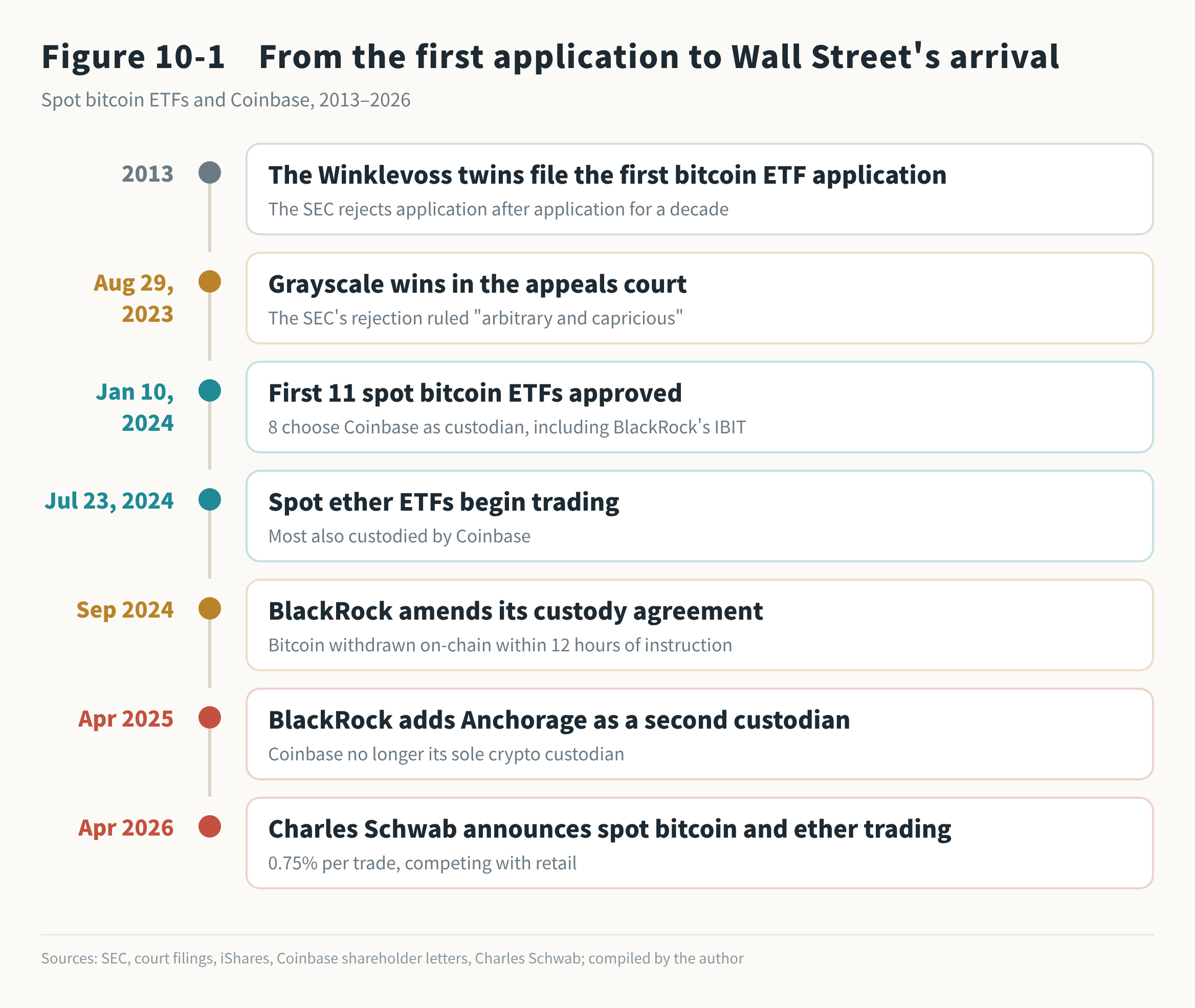
On January 10, 2024, the US Securities and Exchange Commission approved the first 11 spot bitcoin ETFs.
The crypto industry had waited ten years for this moment. The Winklevoss twins filed the first bitcoin ETF application back in 2013, and over the next decade the SEC rejected one application after another. Then, in August 2023, the crypto asset manager Grayscale won its lawsuit against the SEC in a federal appeals court. On August 29, the court ruled that the SEC’s rejection of its application was “arbitrary and capricious”: the SEC could not explain why it had approved bitcoin futures ETFs but not spot ETFs. The SEC did not appeal, and in the end it relented.
The list of approved issuers read like a who’s who of Wall Street asset management: BlackRock, Fidelity, Invesco, Franklin Templeton, ARK…
And behind that list was another one: who would hold the bitcoin these ETFs owned?
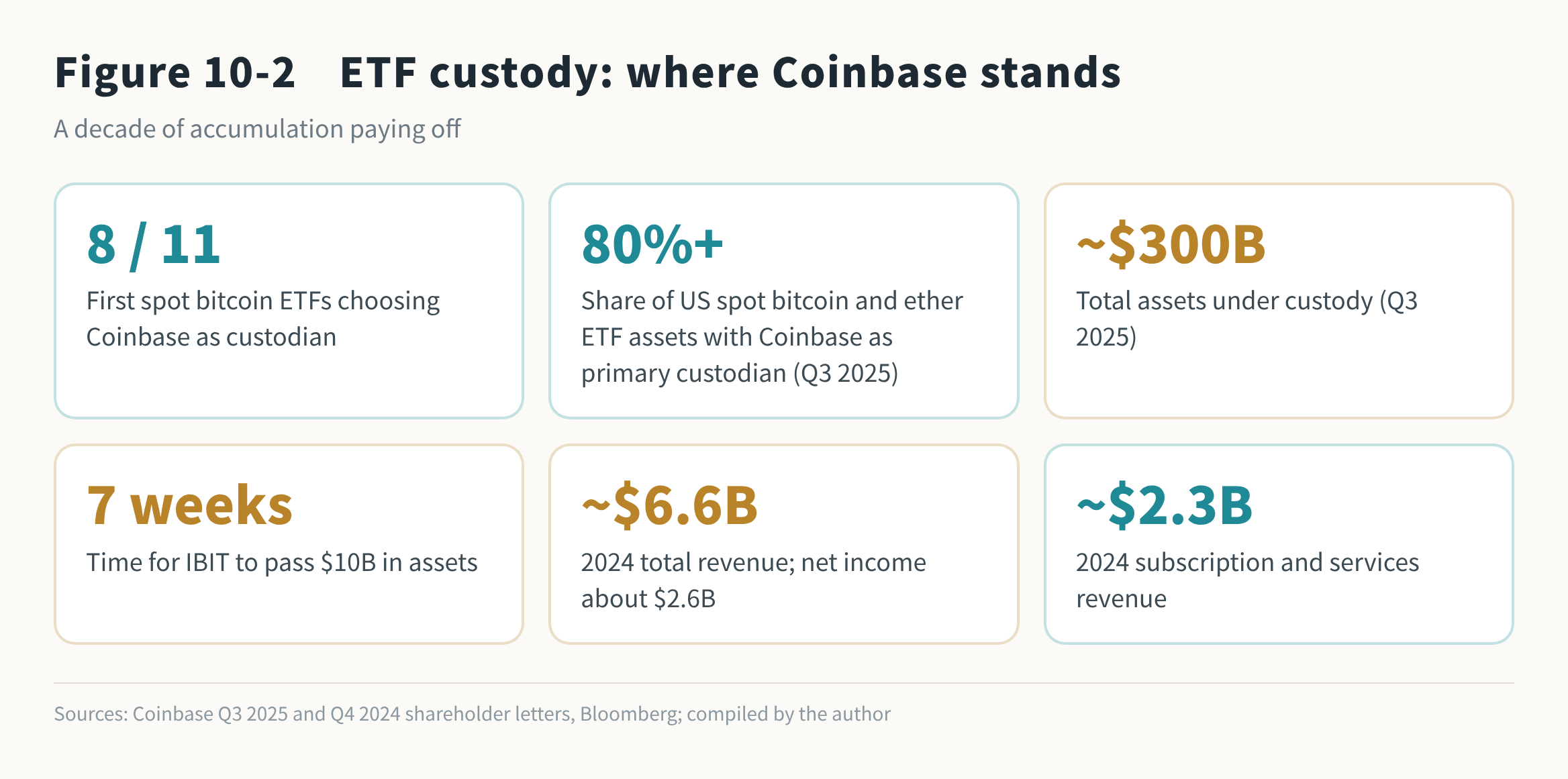
The answer: of the 11 ETFs, 8 chose Coinbase as custodian, including the largest, BlackRock’s iShares Bitcoin Trust (IBIT).
The custody seed planted in the 2018 winter had, at this moment, grown into a tree.
But in the shade of that tree lay a new problem: Wall Street was Coinbase’s biggest client, and it was also becoming its most powerful competitor.
1. Why Coinbase
Why did Wall Street’s biggest asset managers almost all choose Coinbase?
The answer runs through every chapter of this book:
- Licenses and regulation: Coinbase held a New York trust charter and was a regulated qualified custodian, a hard requirement of institutions’ compliance departments.
- Exchange and liquidity: Coinbase ran the largest regulated crypto exchange in the US. ETFs needed to buy and sell large amounts of bitcoin every day, and Coinbase could provide custody and trade execution together.
- Custody experience: Since 2018, Coinbase had held crypto assets for institutional clients for years, with a mature cold storage system and a strong security record.
- Public-company transparency: As a public company, Coinbase’s finances were public and audited, so institutions could assess its risk as a counterparty.
- Still standing after the crisis: After FTX collapsed, institutions were extremely sensitive to “exchange risk,” and Coinbase was one of the few large platforms that had come through the 2022 chain of collapses without trouble.
BlackRock’s choice wasn’t sudden either. Back on August 4, 2022, while the crypto market was still in the middle of its collapses, BlackRock announced a partnership with Coinbase: institutional clients of BlackRock’s Aladdin investment management system who were also Coinbase clients could trade and hold crypto directly through Coinbase Prime, starting with bitcoin. The ETF custody agreement signed a year and a half later was built on that relationship.
This was a moment when ten years of accumulation paid off at once. No single decision won Coinbase these custody contracts. They were won by every “clumsy” choice of the past decade added together.
2. The ETF boom
Spot bitcoin ETFs were a success beyond anyone’s expectations.
BlackRock’s IBIT passed $10 billion in assets just seven weeks after listing, one of the fastest-growing ETFs in history. By mid-2025, its net assets had at one point exceeded $70 billion.
Then, on July 23, 2024, nine spot ether ETFs began trading, most of which also chose Coinbase as custodian (seven, according to Coinbase’s Q3 2025 shareholder letter).
According to that same Q3 2025 shareholder letter, Coinbase was the primary custodian for more than 80 percent of the assets in US spot bitcoin and ether ETFs, and the company held about $300 billion in total assets under custody.
For Coinbase, the ETFs brought several kinds of benefit:
- Custody fees: ETF issuers pay for custody. The rates are low, but the scale is huge.
- Trade execution: ETF creations and redemptions require buying and selling bitcoin, and many issuers do this through the Coinbase Prime institutional platform.
- Brand endorsement: Being chosen as custodian by BlackRock and other Wall Street giants was itself the highest endorsement of Coinbase’s security and compliance.
- A bigger market: ETFs brought in large amounts of money that previously couldn’t or wouldn’t hold crypto directly, pushing bitcoin’s price up and with it Coinbase’s retail trading volume.
These benefits soon showed up in the books. In 2024, Coinbase’s total revenue was about $6.6 billion and its net income about $2.6 billion; subscription and services revenue, which includes stablecoins, custody and staking and doesn’t depend on trading volume, was about $2.3 billion. Compared with the $2.6 billion loss of 2022, it was a complete reversal.
3. Client or competitor?
But the ETFs’ success also raised a question Coinbase didn’t much like.
Before ETFs, the easiest way for an ordinary American to buy bitcoin was to open a Coinbase account. Now they only had to open their existing account at Schwab, Fidelity or Robinhood and buy IBIT like a stock. No new app to download, no private keys to manage, no worries about exchange security, and a bitcoin ETF can go into a retirement account.
More importantly, buying an ETF might cost less than buying bitcoin on Coinbase. IBIT’s annual fee was only a fraction of a percent, while Coinbase’s retail trading fees had long been among the most expensive in the industry.
That meant: ETFs were competing with Coinbase’s retail business for the same users. For ordinary investors who just wanted to “buy a little bitcoin and hold it,” an ETF might be a better choice than Coinbase.
And Wall Street’s challenge didn’t stop there:
- Fidelity chose to custody its bitcoin ETF’s assets itself rather than hand them to Coinbase. Large financial institutions had both the ability and the will to build their own crypto custody.
- The biggest client also writes the rules. In September 2024, after speculation spread that Coinbase might be using “paper bitcoin” to meet ETF creations, BlackRock amended its custody agreement with Coinbase: Coinbase must withdraw bitcoin to a specified on-chain address within 12 hours of receiving instructions. Armstrong said publicly that all ETF buys and sells settle on-chain. The rumor was never substantiated, but the amendment showed that Wall Street, while handing its money to Coinbase for safekeeping, was also writing Coinbase’s obligations into the contract one clause at a time.
- In April 2025, BlackRock added a second custodian, Anchorage Digital, for IBIT and its ether ETF, ending Coinbase’s status as its sole crypto custodian. BlackRock said this was part of its “ongoing approach to risk management,” that it had no current plans to move assets, but that it reserved the right to allocate assets between the two.
- Concern about concentrated custody was growing in the industry: with more than 80 percent of ETF assets in one custodian’s hands, any problem at Coinbase would hit the entire ETF market. The very discussion of this “single point of failure” pushed issuers to diversify custody.
- Traditional brokers began selling crypto directly. In April 2026, Charles Schwab announced spot bitcoin and ether trading, rolling it out to retail clients in phases from May, at 0.75 percent per trade, competing directly with Coinbase’s retail business.
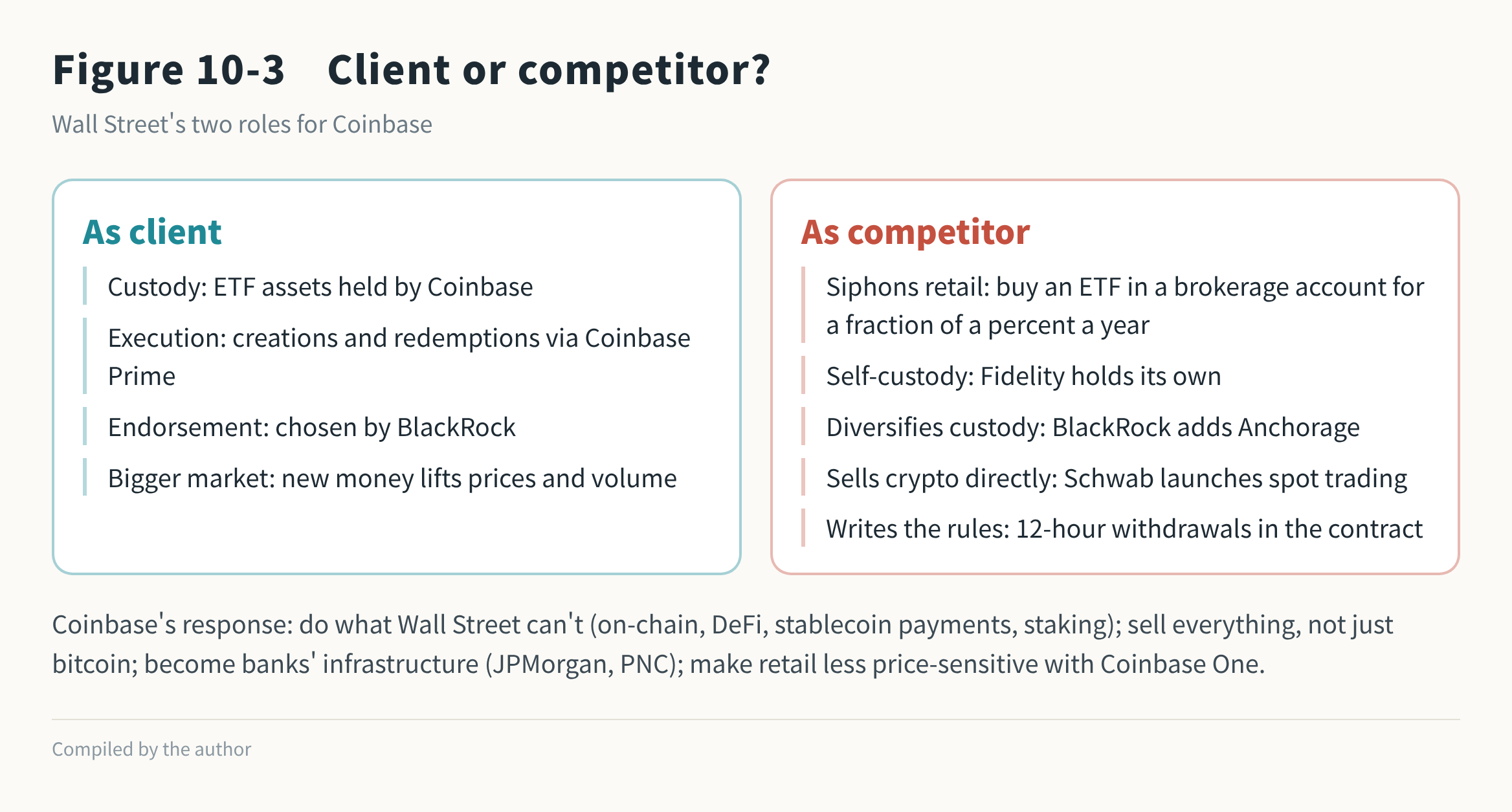
This was the new landscape Coinbase faced after 2024: its biggest clients were also its biggest potential competitors. Wall Street needed Coinbase’s custody and trading infrastructure to enter crypto, but once it was in, had learned the ropes and built its own capabilities, Coinbase’s position would be challenged.
4. Coinbase’s response
Facing this new landscape, Coinbase’s strategy can be summed up in four points:
First, do what Wall Street can’t. ETFs give investors only price exposure to bitcoin and ether; they don’t let them use crypto: no on-chain transfers, no DeFi, no stablecoin payments, no staking yield. Those are exactly what Coinbase and Base can offer.
Second, move from “selling bitcoin” to “selling everything.” If the plain business of buying and selling bitcoin would be siphoned off by ETFs, Coinbase needed to offer more products ETFs couldn’t: derivatives, more tokens, prediction markets, tokenized stocks. That became the later “everything exchange” strategy.
Third, get banks to treat Coinbase as a utility. Rather than fight banks for customers, let banks’ customers enter the crypto world through Coinbase. In July 2025, the US regional bank PNC announced it would let its clients buy, hold and sell crypto through Coinbase’s “crypto-as-a-service” platform. A week later, JPMorgan announced a partnership with Coinbase: Chase credit cards could fund Coinbase accounts; Chase credit card points could be converted into USDC at 100 points to $1; and Chase bank accounts could link directly to Coinbase wallets through JPMorgan’s own API.
More than a decade earlier, Coinbase had worked hard just to persuade banks to deal with it. Now America’s largest bank was voluntarily plugging its customers, its rewards points and its API into Coinbase. At the retail level, banks and brokers were competitors; at the infrastructure layer, they had become clients.
Fourth, make retail users less price-sensitive. With the Coinbase One subscription, formally launched in 2023 at $29.99 a month, users paid a fixed monthly fee for benefits including zero trading fees (the spread still applied). It answered the criticism that “Coinbase is too expensive” and turned some volatile trading revenue into steadier subscription revenue.
5. Looking back: judgment or luck?
Long-term accumulation paying off: Becoming the main custodian for the ETFs was the concentrated payoff of a decade of compliance choices. It wasn’t one decision but the inevitable result of a chain of decisions.
The luck: The timing of spot ETF approval depended heavily on Grayscale’s win in court and the SEC’s change of stance, neither of which Coinbase controlled.
The real challenge: Over the long run, the ETFs’ success may weaken Coinbase’s retail business. It is a classic “innovator’s dilemma”: Coinbase helped Wall Street into crypto, and once in, Wall Street will use its own channels and pricing power to compete with Coinbase for users.
What if Coinbase had refused to provide custody for the ETFs?
The ETFs would have listed anyway, just with different custodians: Fidelity itself, Gemini, Anchorage, or other banks. Coinbase would have lost not only custody revenue and the brand endorsement but also its central position in this new market. Better to do it yourself than let someone else, even if it means helping a future competitor in some way. It’s the same logic as building its own exchange and accepting self-cannibalization in Chapter 3.
The lesson of this chapter: when a bigger player enters your market, the best position isn’t standing in its way but standing beneath it, as infrastructure it can’t do without; and at the same time, you must move quickly to do what it can’t.
Decision Card
- Situation: 2024: spot bitcoin ETFs approved, Wall Street pouring into crypto, and ETFs threatening to siphon off Coinbase’s retail users
- Options: A: refuse to cooperate and protect the retail business B: become the ETFs’ custody and trading infrastructure while building businesses ETFs can’t offer
- Choice: B: became custodian for 8 of the 11 bitcoin ETFs, while pushing on-chain products, the everything exchange, bank partnerships and subscriptions
- Outcome: Custody assets grew sharply and the brand gained endorsement; but long-term pressure from custody diversification (BlackRock adding Anchorage) and retail users being siphoned off
- Lesson: When a bigger player enters, don’t stand in its way; become its infrastructure, and move quickly to do what it can’t
Key line: Wall Street needs you to let it in. Once it’s in, it starts learning your business.
Sources
- Coinbase as custodian for 8 of 11 bitcoin ETFs: Coinbase Blog: How we keep digital assets safe
- ETF custody share and total assets under custody: KuCoin News (citing Bitwise); Crypto Briefing; Bitcoin News; Value The Markets
- BlackRock adding Anchorage as custodian: Decrypt; ETF.com; The Defiant
- The Grayscale ruling: Cointelegraph
- Ether ETF listings: The Block, 2024-07-23; Blockworks
- Charles Schwab: The Block, 2026-04-16; The Block
- Coinbase One: Blockworks
- Full-year 2024 results: Coinbase Q4 2024 shareholder letter; Coinbase 2024 10-K
- BlackRock’s custody agreement amendment (12-hour withdrawals): iShares IBIT 8-K, 2024-09-19; CryptoSlate; BeInCrypto
- BlackRock Aladdin and Coinbase Prime partnership: Coinbase Blog, 2022-08-04; The Block
- JPMorgan and PNC partnerships: The Block, 2025-07-30; Banking Dive; Nasdaq
From my new book Coinbase: On the Side of the Rules: https://pickful.ai/books/tqn4
转发此帖子?
与您的关注者分享。
回复