
目錄(9 節)

·
"No Bill Is Better Than a Bad Bill": From Defendant to Rule-Maker
2025 The SEC drops its case, a ransom refused, the S&P 500, the GENIUS Act and the Deribit acquisition
In May 2025, someone sent Coinbase an extortion letter.
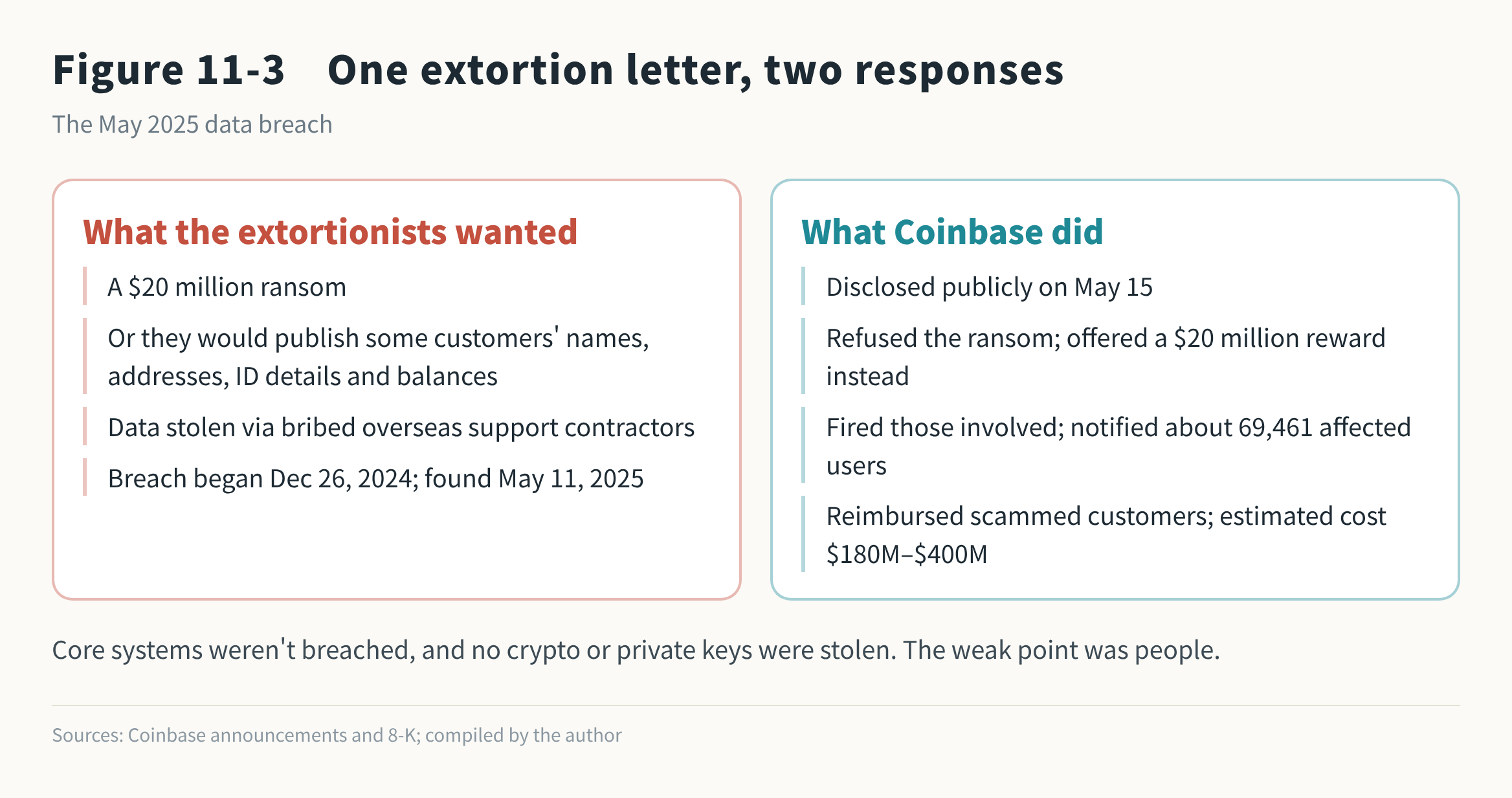
The senders claimed they had obtained personal information on some Coinbase customers: names, addresses, ID details, account balances… If Coinbase didn’t pay $20 million, they would make the data public.
The investigation quickly established how the data had leaked: a group of outsiders had bribed several of Coinbase’s overseas customer support contractors to use their internal system access to steal some users’ account data, and then used that data to impersonate Coinbase support and defraud users.
On May 15, Coinbase disclosed the incident publicly and gave its answer:
It would not pay the ransom.
More than that, Coinbase announced a $20 million reward fund for information leading to the arrest and conviction of the criminals. The $20 million that was supposed to go to the extortionists became $20 million offered for their capture.
Coinbase immediately fired the contractors involved, notified affected users, and promised to reimburse customers who had been scammed as a result. About 69,461 users were affected, less than 1 percent of monthly transacting users. The breach began as early as December 26, 2024 and wasn’t discovered until May 11, 2025. The company initially estimated the cost of remediation, security upgrades and customer reimbursement at $180 million to $400 million.
It was a crisis Coinbase faced in 2025. But compared with everything else that happened that year, it was almost an interlude.
2025 was the year Coinbase went from being “an object of regulation” to “a participant in the rules.”
1. The SEC drops its case
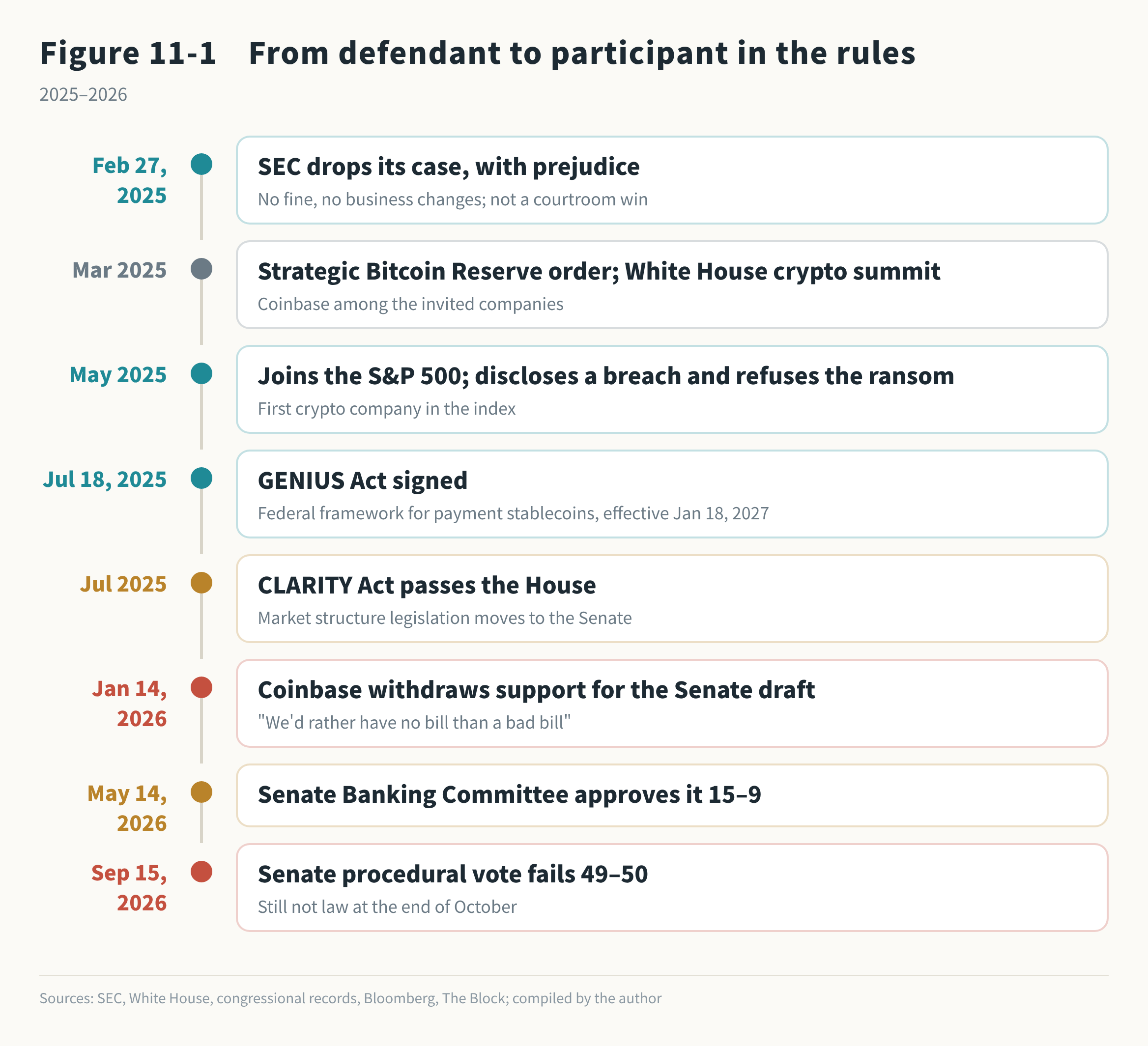
On February 21, 2025, Coinbase announced that SEC staff had agreed in principle to dismiss the case against it, pending the commission’s final approval.
On February 27, the SEC formally announced the dismissal. The case ended “with prejudice,” meaning the SEC cannot sue again on the same grounds. Armstrong said Coinbase would pay no fine and make no changes to its business.
And so the lawsuit that began in June 2023 was over.
To be clear: Coinbase did not win this case in court. The March 2024 initial ruling had been quite unfavorable to it, and the outcome of a trial would have been hard to predict. The real reason the SEC dropped the case was the fundamental shift in the regulatory environment after the 2024 US election: a new administration took office, SEC leadership changed, and the new leadership said explicitly that it wanted to build a clear regulatory framework for crypto assets rather than continue “regulation by enforcement.”
Along with dropping the case, the SEC committed to developing a regulatory framework for crypto assets. That was exactly what Coinbase had asked for in its 2022 petition to the SEC.
The case’s ending is directly linked to the political involvement in Chapter 9. Coinbase didn’t win in court, but it “won” at the ballot box.
2. Rules take shape
After the dismissal, the crypto industry saw a series of institutional changes.
On March 6, 2025, the US president signed Executive Order 14233 establishing a “Strategic Bitcoin Reserve”; the next day the White House held its first crypto summit, and Coinbase was one of the companies invited.
On July 18, 2025, the GENIUS Act (the Guiding and Establishing National Innovation for US Stablecoins Act), the first federal law dedicated to the crypto industry, was signed into law, taking effect on January 18, 2027. It created a federal regulatory framework for “payment stablecoins”: issuers must be licensed, must hold one-to-one reserves in highly liquid assets such as cash and short-term US Treasuries, and must regularly disclose the composition of their reserves.
For Coinbase, the GENIUS Act mattered especially:
- USDC gained clear legal status. USDC, launched with Circle in 2018, had been designed from the start around “full reserves and regular attestations”, closely matching the GENIUS Act’s requirements. Compliant stablecoins now had the backing of law.
- Stablecoin revenue gained a firmer foundation. Before the law, the stablecoin business always faced regulatory uncertainty; with the law in place, more institutions and businesses could use stablecoins with confidence, driving USDC’s growth and with it Coinbase’s stablecoin revenue.
- The bar for competition rose. Stablecoins that didn’t meet federal standards would face growing restrictions in the US market.
Meanwhile, more comprehensive legislation on crypto market structure (spelling out which tokens are securities and which are commodities, and which agency regulates them) was also moving through Congress. The CLARITY Act passed the House in July 2025 and moved to the Senate.
3. “We’d rather have no bill than a bad bill”
Taking part in writing the rules doesn’t mean the rules will be written your way.
On January 14, 2026, the Senate Banking Committee was due to mark up a draft of the market structure bill the next day. The day before, Armstrong announced that Coinbase could not support the draft. The reasons included limits on tokenized stocks, limits on stablecoin rewards, excessive requirements on decentralized finance protocols, and too much power for regulators. In Armstrong’s words: “We’d rather have no bill than a bad bill.”
The most sensitive issue was stablecoin rewards. Under the GENIUS Act, stablecoin issuers themselves cannot pay interest to holders; but platforms like Coinbase could use their share of reserve income to pay rewards to users who held USDC. The banking industry argued that this was interest by another name that would pull deposits out of banks, and pushed to close the gap in the new bill. For Coinbase, it went to the heart of one of its most important sources of profit.
The committee’s markup was promptly postponed. The White House expressed disappointment with Coinbase’s move, and for a while there were reports that it was considering withdrawing support for the bill. A few days later, Armstrong negotiated with bank executives at Davos and said Coinbase was still optimistic about the bill.
The scene stood in sharp contrast to a decade earlier. In 2014, Coinbase was still applying for money transmitter licenses state by state and waiting for regulators to review it. In 2026, it was haggling with the banking industry over the text of a bill in Congress, and its stance could delay a committee markup.
The bill did move a step further: on May 14, 2026, the Senate Banking Committee approved an amended version 15 to 9. But on the Senate floor it stalled: on September 15, a procedural vote to advance the bill failed 49 to 50, well short of the 60 votes needed. That day, Senator Tillis filed a motion to reconsider, leaving a path to revisit the bill later. According to some reports, one point of contention was an ethics provision on crypto holdings by the president’s family. As of early November 2026, the Senate had scheduled no new vote and the bill had still not become law; and the next step depended on the November midterms and the Congress that followed.
From 2012, when Coinbase chose to stand on the side of the rules in an industry with “no rules,” to 2025, when it helped push the rules into being, the road took thirteen years. But this scene from 2026 also shows: once you become a participant in the rules, you no longer face only the regulators, but every other interest that also wants a hand in writing them.
4. Joining the S&P 500
In May 2025, Coinbase was added to the S&P 500, the first crypto company in the index. Before the open on May 19, it formally replaced Discover Financial, which was about to be acquired.
The S&P 500 is one of the most important benchmarks in the US stock market. Joining it meant that index funds and passive money worth trillions of dollars around the world had to buy Coinbase shares according to its weight.
More importantly, it was a confirmation of identity: a crypto company recognized as one of America’s 500 most important public companies.
Go back to Chapter 2: when Mt. Gox went bankrupt in 2014, “bitcoin is dead” headlines filled the media. Eleven years later, Coinbase sat in the same index as Apple, Microsoft and JPMorgan.
5. Buying Deribit: into global derivatives
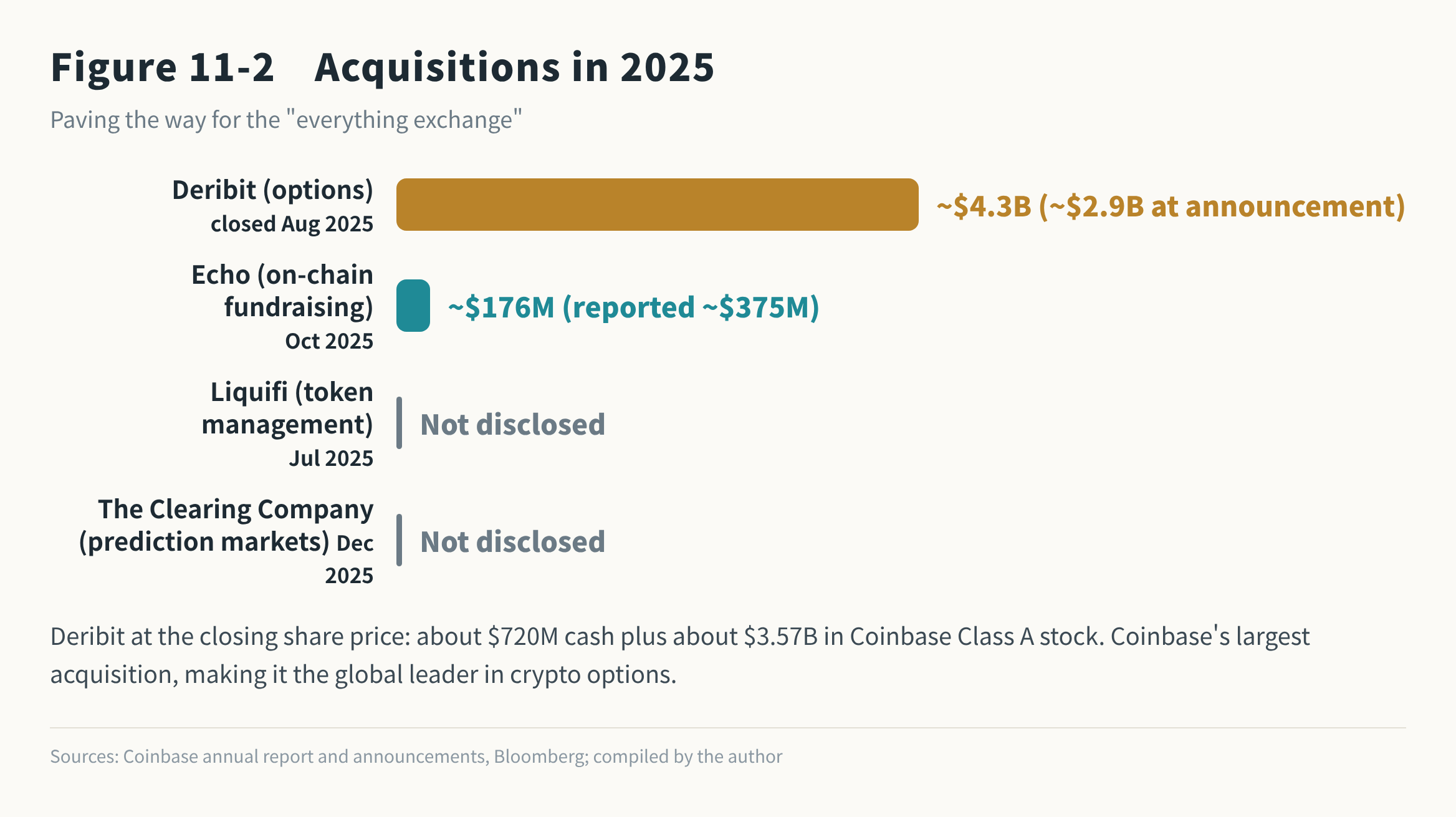
In May 2025, Coinbase announced it would acquire Deribit, the world’s largest crypto options exchange. The deal closed on August 14.
At announcement, the price was reported at about $2.9 billion. But according to figures Coinbase later disclosed in its annual report, because the deal was paid largely in Coinbase stock, the total consideration at the closing share price was about $4.3 billion: about $720 million in cash and about $3.57 billion in Coinbase Class A common stock. It was the largest acquisition in Coinbase’s history and one of the largest in the crypto industry.
Why buy Deribit?
In global crypto markets, derivatives volume far exceeds spot. Futures, options and perpetual contracts are the main trading tools of professional traders and institutional investors. In this market Coinbase had long been on the sidelines; it was dominated by offshore exchanges such as Binance and, in options, by Deribit.
Buying Deribit made Coinbase the leader in global crypto options at a stroke and greatly expanded its business outside the US. Together with Coinbase International Exchange, launched in 2023, it formed Coinbase’s push into global derivatives.
In Coinbase’s own words, the deal was central to its goal of becoming “the premier global crypto derivatives platform.”
That same year, Coinbase completed a series of smaller acquisitions: in July, the token management platform Liquifi, expanding into tokenization and digital cap tables; in October, the on-chain fundraising platform Echo (news reports put the price at about $375 million, while company filings record purchase consideration of about $176 million); and in December, the prediction market company The Clearing Company. All of these paved the way for the “everything exchange” strategy in Chapter 12.
6. Back to the extortion letter
Now look again at the data breach from the start of this chapter.
It shows an important fact: even in its most glorious year, Coinbase still had to face its most fundamental risks: security and trust.
In this incident, Coinbase’s core systems weren’t breached, and users’ crypto assets and private keys weren’t stolen. But it exposed a new weak point: people. In a company with over a hundred million users, thousands of employees and many contractors, anyone with system access can become an attacker’s way in.
Coinbase’s response continued the posture it has shown throughout this book:
- Disclose publicly rather than conceal (the public-company transparency of Chapter 6);
- Refuse to give in rather than pay a ransom (the stance of standing up to the IRS in Chapter 2);
- Reimburse users rather than shift the blame (the Chapter 1 promise that “holding it for you means being responsible”).
A cost of $180 million to $400 million is high. But if it had paid a $20 million ransom, it would have announced to criminals worldwide that Coinbase could be extorted.
7. Looking back: judgment or luck?
The luck: The fundamental shift in the 2025 regulatory environment was largely a product of the 2024 US election. Had the election gone differently, the SEC case might have continued and the GENIUS Act might not have passed so quickly. Coinbase’s political involvement played a part, but election outcomes are decided by countless factors far beyond any one company’s control.
Long-term choices paying off: Coinbase was able to benefit quickly once the environment changed because, for more than a decade, it had built its business to the standard of “we will be regulated.” USDC met the GENIUS Act’s requirements, and Coinbase’s compliance systems could plug directly into the new framework. None of that happens overnight.
The judgment: Buying Deribit was a bold strategic call. Making a large acquisition mainly with stock, when the regulatory environment had improved and the share price was high, both seized the moment and closed Coinbase’s gap in global derivatives in one move.
The contested part: Withdrawing support for the market structure bill was a very public show of toughness. It protected core interests such as stablecoin rewards, but it also led some politicians, for the first time, to see Coinbase as a company “holding up the whole industry’s legislation for its own business.” Becoming a participant in the rules means every position you take will be scrutinized as an interest.
What to watch out for: The Coinbase of 2025 was in an unprecedentedly favorable position. But as Chapter 6 said, what you gain at the peak comes with the peak’s expectations. The regulatory environment can improve with one election and worsen with another. And crypto’s cycles never stop because a company joins the S&P 500.
The lesson of this chapter: when the rules change, the biggest winners aren’t the companies that lobbied hardest, but those that always built themselves to the standard that “the rules will eventually come.”
Decision Card
- Situation: 2025: the regulatory environment turned, the SEC dropped its case and stablecoin legislation passed; at the same time, an insider data breach and extortion attempt
- Options: A: run conservatively in the favorable environment and protect existing businesses B: use the momentum to expand at scale while holding to principle in the crisis
- Choice: B: bought Deribit to enter global derivatives, pushed stablecoin and market structure legislation; refused a $20 million ransom and offered a reward instead
- Outcome: Joined the S&P 500, became the global options leader, and USDC gained legal status; the breach cost $180 million to $400 million
- Lesson: When the rules change, the biggest winners are those that always built themselves to the standard that “the rules will eventually come”
Key line: It didn’t win in court, but it won in the rules; and winning the rules depended on deciding thirteen years earlier to play by them.
Sources
- The data breach and refusal to pay: The Register, 2025-05-15; Insurance Journal; Forklog; Security Affairs
- The SEC dismissal: CoinDesk, 2025-02-27; Bloomberg, 2025-02-21; The Block; Axios
- Deribit consideration: Coinbase 2025 10-K; StreetInsider
- The Echo acquisition: Decrypt; Coinbase 2026 10-Q
- 2025–2026 acquisitions and strategy: Coinbase Q3 2026 10-Q; Tracxn
- The executive order and White House summit: UCSB American Presidency Project; Coingape
- The GENIUS Act: Wikipedia: GENIUS Act
- The September 15 procedural vote on the CLARITY Act and later actions: U.S. Senate roll call vote 234; Congress.gov: H.R.3633 actions
- The CLARITY Act: ThinkAdvisor, 2026-05-14; The Defiant
- The S&P 500: The Defiant
- Number of users affected by the breach: TechCrunch, 2025-05-21; Decrypt
- Coinbase withdrawing support for the Senate draft: Bloomberg, 2026-01-14; Decrypt; The Block; White House reaction: Cointelegraph; Davos: The Block; Bloomberg Law
- The September 15 procedural vote and end-of-October status: DeFi Rate; Coinpaprika; Latham & Watkins policy tracker
From my new book Coinbase: On the Side of the Rules: https://pickful.ai/books/tqn4
轉發此貼文?
與您的關注者分享。
回覆