

·
Why the Real Geographic Center of Modern AI Is Not Just Silicon Valley
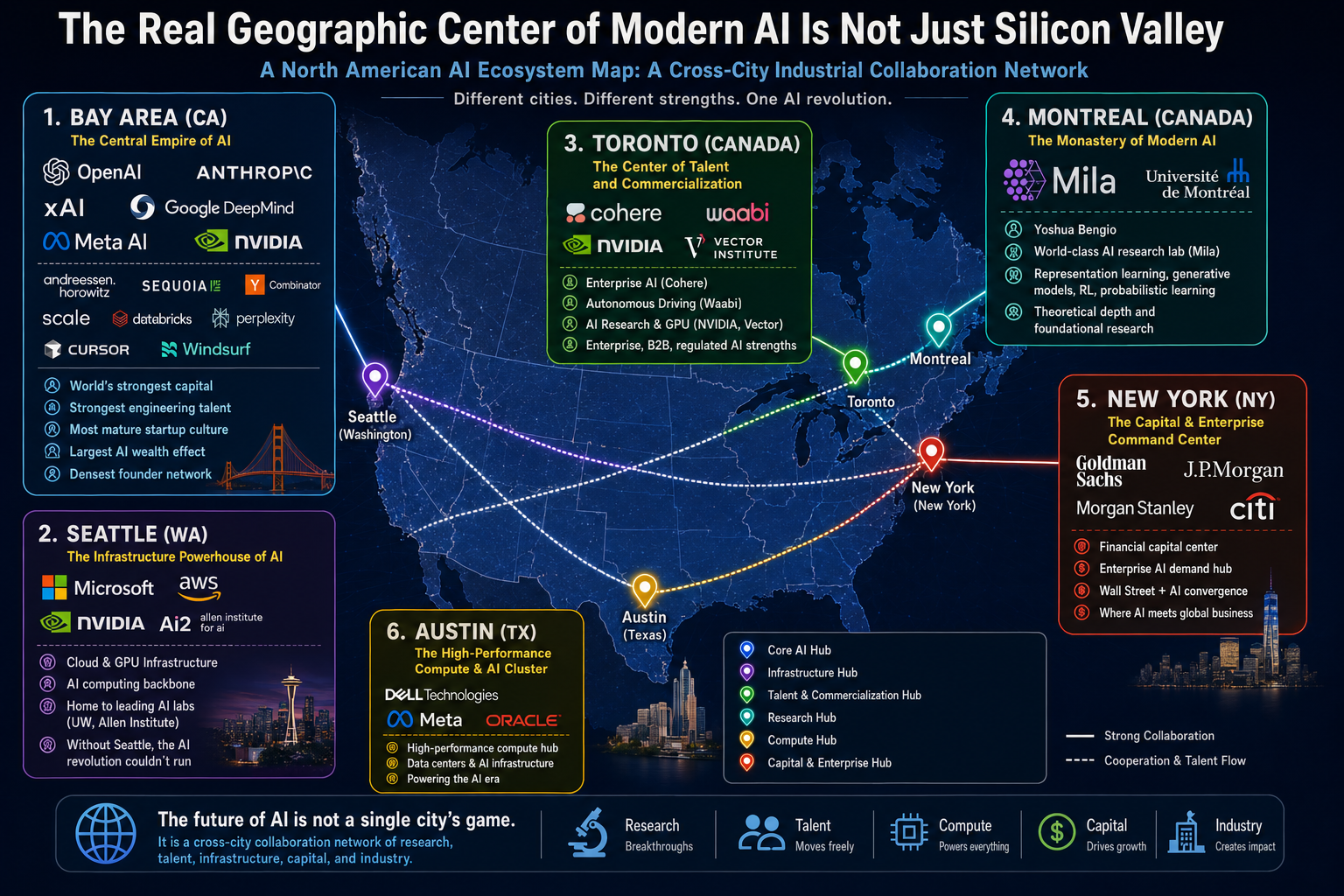
Bay Area leads AI, Toronto supplies talent and commercialization, Montreal anchors research, Seattle powers compute, and New York drives monetization.
A Severely Underestimated North American AI Map
When people talk about AI, they usually think of San Francisco.
OpenAI, Anthropic, xAI, NVIDIA, Meta AI: almost all of the most visible names are in the Bay Area.
So the default assumption becomes:
AI = Silicon Valley.
But if you look at modern AI through the lens of research, talent, infrastructure, and commercialization, a different picture emerges.
Today’s AI ecosystem has already formed a clear North American map, with different cities playing different roles.
Some cities are centers of foundational research.
Some are where models are trained.
Some are where AI gets commercialized.
Some provide GPU and cloud infrastructure.
Some concentrate financial capital and enterprise demand.
The real structure of modern AI is increasingly becoming:
a cross-city industrial collaboration network.
Not:
"everything is in Silicon Valley."
1. The Bay Area: The Central Empire of AI
Let’s start with the obvious conclusion:
The Bay Area is still the undisputed center of global AI.
And by a wide margin.
It is home to:
- OpenAI
- Anthropic
- xAI
- core Google DeepMind teams
- Meta AI
- NVIDIA’s core ecosystem
- Andreessen Horowitz
- Sequoia
- YC
- Scale AI
- Databricks
- Perplexity
- Cursor
- Windsurf
Almost every major frontier-model company, AI infrastructure startup, AI agent company, and developer-tool company is here.
The reason is straightforward.
The Bay Area has:
- the world’s strongest capital;
- the world’s strongest engineering talent;
- the most mature startup culture;
- the largest AI wealth effect;
- the densest founder network.
In AI, the most important thing is often not just technology.
It is whether you can:
- raise money;
- hire quickly;
- scale fast;
- build an ecosystem around you.
The Bay Area remains unmatched on all of those dimensions.
So when people say:
"AI is the new internet,"
the more accurate version may be:
"AI is recreating Silicon Valley’s dominance from the internet era."
2. Toronto: The Center of Talent and Commercialization
Once you step outside the Bay Area, one of the most important AI cities today is Toronto.
Many people still think of Toronto as:
- Canada’s largest city;
- a financial center;
- expensive real estate;
- a large Chinese community.
But in reality, Toronto is becoming:
one of the world’s most important AI talent hubs.
Why Toronto Rose
The answer comes down to three names:
- Geoffrey Hinton
- University of Toronto
- Vector Institute
Geoffrey Hinton is one of the three giants of modern deep learning.
Many of the core ideas behind today’s LLMs can be traced back to early work on:
- backpropagation;
- representation learning;
- neural network scaling.
Toronto is one of the most important birthplaces of the deep learning tradition.
Later on, major companies such as:
- NVIDIA
- Uber
- Cohere
- Waabi
all built AI teams in Toronto.
What they were really competing for was not just market share.
It was:
AI talent.
Toronto’s Distinct AI Character
Toronto is not like San Francisco, which is:
- consumer internet-driven;
- hype-driven;
- VC-driven.
Toronto is more oriented toward:
- enterprise AI;
- B2B;
- autonomous driving;
- regulated AI;
- developer infrastructure.
That reflects Canada’s broader economic structure.
Canada is strong in:
- finance;
- SaaS;
- stable regulation;
- engineering culture.
As a result, Toronto’s AI startups often take on a more industrial, disciplined character.
Toronto’s Representative Directions
1. Enterprise AI
Representative company:
- Cohere
Compared with OpenAI’s consumer-first path, Cohere is closer to:
an enterprise AI infrastructure company.
Its focus includes:
- private enterprise models;
- enterprise-grade RAG;
- security and compliance;
- enterprise deployment.
That fits Toronto’s character extremely well.
2. Autonomous Driving
Representative company:
- Waabi
Founder Raquel Urtasun was formerly Uber ATG’s Chief Scientist.
Waabi’s core direction is not simply autonomous driving.
It is:
world models plus generative simulation.
In essence, it is working on Physical AI.
3. AI Research and GPU
Represented by:
- NVIDIA Toronto
- Vector Institute
Toronto has become one of NVIDIA’s important global AI research nodes.
It is especially strong in:
- computer vision;
- robotics;
- 3D world models.
3. Montreal: The Monastery of Modern AI
If Toronto is the city of AI industrialization, Montreal is more like:
the sacred ground of foundational AI research.
Why Montreal Matters
Because it has:
- Yoshua Bengio
- Mila
Yoshua Bengio is one of the three giants of modern deep learning.
Mila is one of the largest AI academic labs in the world.
What many people do not realize is this:
Around 2010, deep learning was not mainstream.
At the time, many people in academia believed:
- neural networks had no future;
- they were not interpretable;
- they required too much compute;
- traditional machine learning was better.
But the Montreal school kept believing in neural networks.
Eventually, the entire world proved them right.
Montreal’s Core Advantage
Montreal is not about startups.
It is not about VC.
It is not about commercialization.
It is about:
foundational research.
Its focus includes:
- representation learning;
- generative modeling;
- RL;
- probabilistic learning;
- sequence modeling.
These are the deep underlying problems.
So Montreal is like:
the theoretical physics institute of the AI world.
And Toronto is more like:
the industrial base of AI.
4. Seattle: The True Infrastructure Powerhouse of AI
Many people underestimate Seattle.
But without Seattle, today’s AI revolution might not have been possible at all.
Because Seattle is home to:
- Microsoft
- AWS
- Azure
- cloud infrastructure
A large share of the core resources behind modern AI sit there.
The essence of AI is:
a compute war.
And Seattle controls:
- cloud;
- data centers;
- enterprise computing resources.
Many AI companies may look like they are based in San Francisco.
But underneath, they are running on Seattle’s cloud.
5. New York: The AI Commercialization City
If:
- SF is responsible for models;
- Montreal is responsible for theory;
- Toronto is responsible for industrialization;
- Seattle is responsible for compute;
then New York is responsible for:
monetization.
Because New York has:
- finance;
- healthcare;
- advertising;
- legal services;
- media;
- enterprise services.
These are exactly the sectors that are willing to pay for AI.
That is why New York is so strong in:
- AI applications;
- AI SaaS;
- vertical AI;
- financial AI.
Many AI companies eventually realize:
The model is not the hardest part.
The real hard part is:
finding a paying use case.
And New York has the densest concentration of enterprise customers in the world.
6. Why Canada’s Role in Modern AI Is Underestimated
Over the past decade, Canada has served as:
an incubator for foundational AI research.
Not as:
a global commercial center.
A lot of the research:
- happens in Toronto;
- gets published in Montreal;
- and is later commercialized in San Francisco.
That leads many people to assume:
"AI is all built in the United States."
But in reality, Canada has participated in almost the entire theoretical evolution of modern AI.
7. Modern AI Is Creating a City-Based Division of Labor
In the internet era, many things were concentrated in Silicon Valley.
But in the AI era, what is emerging is:
a globally distributed collaboration network.
Because AI spans:
- academia;
- GPUs;
- data centers;
- cloud;
- enterprises;
- finance;
- robotics;
- autonomous driving;
- agents;
- inference infrastructure.
No single city can contain all of that.
So different cities are taking on different roles.
8. The Real Competition Is Not Just About Models
Many people still believe that AI competition is simply about:
"Whose model is stronger?"
But the real competition in the future may be about:
- which city has more AI talent;
- which city has more GPUs;
- which city has more enterprise customers;
- which city has a stronger developer ecosystem;
- which city has stronger energy and data-center capacity;
- which city has more autonomous systems.
In other words:
AI is shifting from:
"model competition"
to
"competition between complete industrial systems."
9. What Really Matters Is the AI City Network
So when looking at AI today, you should not only look at OpenAI.
You should look at how the entire North American AI network is taking shape.
- SF provides capital and frontier models;
- Toronto provides AI talent and enterprise AI;
- Montreal provides foundational research;
- Seattle provides cloud infrastructure;
- New York provides commercialization scenarios.
Together, these cities are forming:
the underlying structure of modern AI civilization.
And this map matters.
Repost this post?
Share with your followers.
Reply